
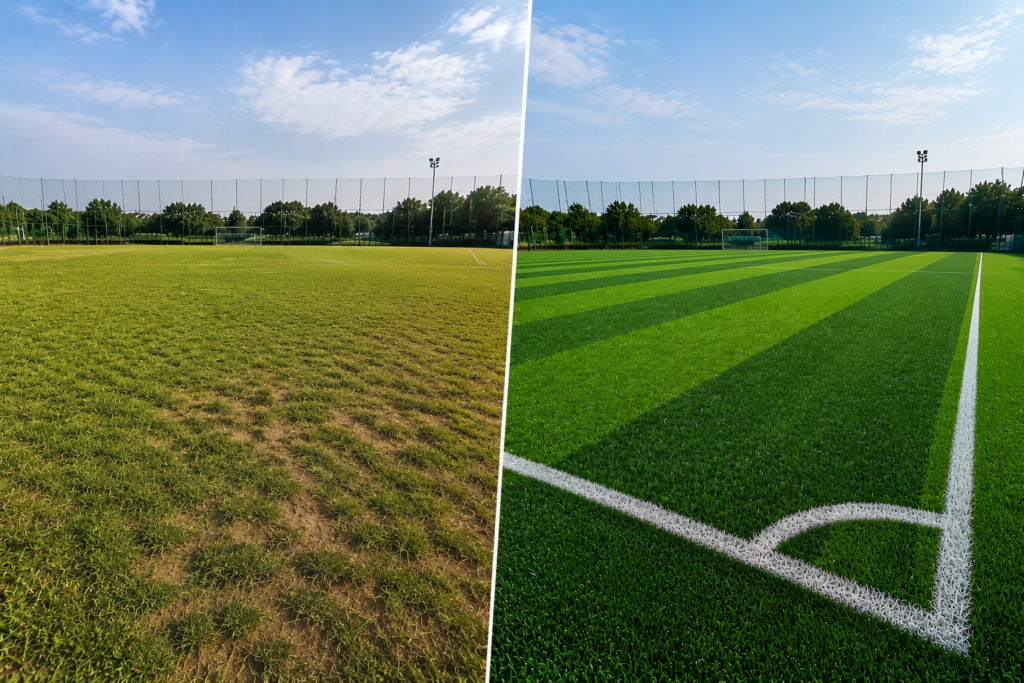
Anyone who’s managed a sports ground in India has lived through the same story. Grass looks great in the brochure photos. Then the monsoon hits and the field turns into a swamp for three weeks straight. Or the dry season rolls in and that same ground goes patchy, hard, and dusty. Somewhere in between all this, someone’s trying to squeeze in a full training schedule on a surface that’s rarely actually ready to use.
Artificial sports turf has become the go-to answer for a lot of schools, academies, and sports complexes – and it’s not because it’s trendy. It’s because it solves problems natural grass genuinely can’t. At A S Sports and Infra, this comes up in almost every conversation with schools and academies planning a new ground.
Weather Just Doesn’t Get a Say Anymore
This is probably the biggest reason facilities make the switch. Natural grass needs the weather to cooperate, and in India, it just doesn’t – not for long stretches, anyway. Heavy rain waterlogs a ground for days, sometimes weeks, depending on how the drainage was originally built. Then peak summer bakes that same ground dry and uneven, turning what was mud a few months back into a hard, cracked surface that’s honestly just as risky to play on. Somewhere in the middle there’s a short window where the field’s actually usable, and that window keeps getting smaller every year as grounds get used more heavily.
Synthetic turf really doesn’t care much either way. It drains properly when it’s built right; it won’t dry out and crack the way soil does, and a ground that used to be usable four days a week suddenly becomes usable almost every single day. For a facility running a packed training calendar – which is most academies in India, let’s be honest – that’s not a small change. It changes what’s actually possible to plan around.
Fewer Injuries, Because the Surface Doesn’t Play Favorites
People often assume artificial turf is harder or riskier than grass. It’s actually the other way around, once it’s installed properly. Natural grass fields end up with soft spots, bald patches, uneven ground from wear – and that unevenness is exactly what causes rolled ankles and bad falls. A ball landing on a bald patch just doesn’t behave the same way as one landing on thick grass, and a player’s foot won’t know the difference until it’s already planted.
A properly built synthetic surface, with the right shock pad and infill, gives consistent footing across the whole field, every day, without exception. Players aren’t relearning the surface every session depending on how recently it rained or how worn the grass is near the goal mouth or the crease. This matters even more for younger athletes still figuring out their movement – a junior academy player training five or six days a week on an inconsistent surface picks up small stresses that a consistent surface just doesn’t create in the same way.
Less Time Maintaining It, More Time Actually Playing on It
Natural grass needs a small army of upkeep. Mowing on a strict schedule, watering timed carefully around the weather, reseeding bald patches before they spread, treating for pests, resting the ground periodically so it can recover from heavy use. Every hour spent on all that is an hour the field isn’t available for practice or a match.
Synthetic turf doesn’t get rid of maintenance entirely, but it flips the equation. There’s still work – brushing to keep the fibers standing up instead of matting down, topping up infill as it settles with use, cleaning off debris now and then. None of it comes close to the constant attention grass demands, though. Facilities that make the switch usually see their ground go from playable a few days a week to playable almost every day, without needing a maintenance crew putting in overtime to make that happen.
Cricket and Football Genuinely Need Different Turf
This bit gets overlooked a lot, but it really does matter. Cricket, football, and multi-sport grounds don’t all need the same turf spec, even if they look pretty similar to the untrained eye. Cricket needs predictable, consistent bounce for batting and bowling alike – a pitch that plays the same on ball one as it does on ball three hundred. This is exactly why cricket turf installation has to be planned around the sport’s specific demands, not treated as a one-size-fits-all job. Football needs turf built for sharp cuts, sprints, constant lateral movement, without too much slide underfoot when players change direction fast.
A ground trying to handle both sports needs turf picked and installed with that in mind – not some generic surface that’s technically fine for neither. This is honestly where a lot of installations go wrong. Someone picks turf based on price or whatever’s easily available, instead of what the sport actually needs from the surface. Getting this sorted at the planning stage, before any turf’s been ordered, saves a lot of headaches down the line.
A Certification Is More Than Just a Sticker
Look for turf tested against recognized standards – FIFA Quality Pro for football, or the equivalent for other sports. These aren’t just marketing badges slapped on a product page for good measure. They mean the turf’s actually been tested for bounce consistency, shock absorption, and durability under real playing conditions in a lab, not just claimed to perform well by whoever’s trying to sell it.
For academies training serious young athletes, good artificial sports turf matters more than people realize at first. A surface that hasn’t been properly tested can behave unpredictably under repeated heavy use – and that’s exactly the kind of use a training academy puts it through, day after day, year after year.
Most turf problems actually start with installation.
Here’s something that doesn’t get said enough – bad turf performance is rarely about the turf material itself. It’s almost always about what’s underneath it. Poor base preparation, weak drainage, uneven grading – these cause the exact same problems people end up blaming on “cheap turf” years down the line, when the real issue was how it got installed in the first place.
Getting the groundwork right – proper base compaction, correct drainage layers, precise leveling before any turf goes down – is really what decides whether an installation lasts its full lifespan or starts showing problems within a couple of years. A rushed job can make even premium turf perform badly, while careful groundwork can get genuinely good results out of a mid-range product. This is the part worth spending real time on, more than obsessing over which brand of turf to buy.
Where This All Lands
Choosing the right artificial sports turf isn’t about chasing a trend. It’s a practical answer to a real problem – weather that natural grass simply can’t handle, maintenance that eats into actual playing time, and the need for a surface that performs the same way today as it will next season. For facilities that depend on consistent, reliable access to their ground, that’s not a minor thing. It’s the difference between a field that’s ready when your players are, and one that just isn’t.