
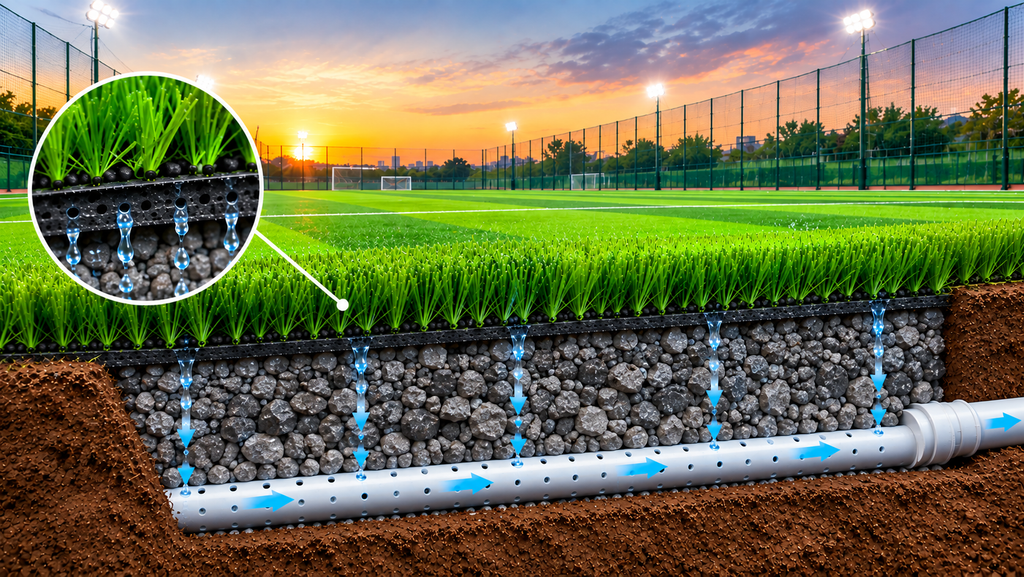
“What happens when it rains -will the ground even be playable the next morning?” Honestly, this is the question we get asked before almost every football or cricket turf project. And the answer’s pretty simple: a properly built artificial turf drainage system shrugs off heavy rain without much drama. A badly built one turns your ground into a swamp for days.
How Turf Drainage Actually Works
Two things do the heavy lifting here:
The turf backing – it’s perforated, meaning tiny holes spread across it let water pass straight through instead of sitting on top.
The base underneath – this is where the real work happens. A properly compacted, graded aggregate base lets water move down and away instead of getting trapped right under the turf.
Skip either of these, and it doesn’t matter how good the turf on top looks – the whole thing underperforms.
Vertical vs Horizontal Drainage: Which One Do You Actually Need
Vertical drainage is the go-to approach most of the time – water just flows straight down through the backing, into the base, and into the soil below. Works great on most ground-level installs where the soil can actually absorb and move that water along.
Horizontal drainage comes in when going straight down isn’t an option – think concrete bases or rooftop setups. Here the surface gets a slight slope built in, so water travels sideways toward drain outlets instead of just sitting there with nowhere to go.
This choice matters way more than people expect at the planning stage. Try using vertical drainage logic on a concrete base, and it just won’t work – water has nowhere to go.
Concrete Base vs a Proper Drainage Layer
This one comes up a lot, especially with box cricket setups where people like the idea of something that feels solid. Concrete is durable, sure, but it has a real problem – it doesn’t drain. Water hitting turf over concrete has nowhere to go except sideways, so now you’re relying entirely on edge drains and channels to do all the work.
A proper aggregate-and-pipe drainage system, on the other hand, lets water move both down and sideways, which handles heavy rain a lot more comfortably. It’s usually cheaper too, since you skip the excavation depth and the cost of pouring and curing concrete.
Concrete still makes sense in some cases – rooftops, or spots that genuinely need a load-bearing base. But even then, horizontal drainage has to be built in deliberately, not assumed to just happen on its own.
Signs Your Drainage Wasn’t Done Right
A few things tend to give it away:
- Puddles that stick around for hours, sometimes days, always in the same spots
- A musty smell that usually means water’s sitting trapped somewhere underneath
- Soft, spongy patches when you walk on it, where the base has softened from moisture
- Turf that’s totally fine when dry but becomes unplayable minutes into rain
If any of this sounds familiar, it’s almost never actually a turf problem – it’s a base and drainage problem.
Keeping It Working Over Time
Even a well-built system needs a bit of upkeep:
- Clear out leaves, dirt, and infill buildup so the drainage holes don’t clog
- Check drainage channels after heavy rain, especially through monsoon season
- Don’t let organic debris just sit there decomposing – it blocks perforations over time
- If puddling starts showing up somewhere it never used to, get the base checked
Drainage Needs Change By Ground Type
Outdoor football and cricket grounds need the most serious drainage setup, given how much rain they take on directly through India’s monsoon months. Box cricket setups, especially the covered ones, don’t need to handle as much runoff, but still need solid base drainage for humidity and whatever water gets in through open sides. Rooftop installs need drainage designed around whatever waterproofing and outlets already exist up there, which usually means going horizontal rather than vertical.
Questions People Usually Ask
If the turf lets water through, why does it need drainage too?
Because that’s only half the job done. Once water passes through the turf, it still needs somewhere to go – without a proper base system, it just sits there trapped and slowly damages everything underneath.
Can you actually put artificial turf on concrete?
Yeah, but you need horizontal drainage built on top of it – a slope plus drain outlets – since concrete itself isn’t going to let water through on its own.
What’s actually different between vertical and horizontal drainage?
Vertical sends water straight down through the base into the soil. Horizontal moves it sideways along a sloped surface toward drain points – you’d use this where vertical isn’t possible, like on concrete.
How do I know if my ground already has a drainage problem?
Puddles that keep showing up in the same spots, a musty smell, or soft patches after rain – these are pretty reliable signs the base needs a look.
Does an outdoor ground need better drainage than a box cricket setup?
Outdoor grounds generally need more robust drainage since they’re taking rain head-on, but covered box cricket setups still need decent base drainage for humidity and any water sneaking in through open sides.
Building a football or cricket turf ground and want the drainage sorted from day one instead of patched later? We handle complete site assessment and drainage design as part of every installation – whether it’s a full-size ground or a box cricket setup where getting the cost and specs right from the start matters just as muc