
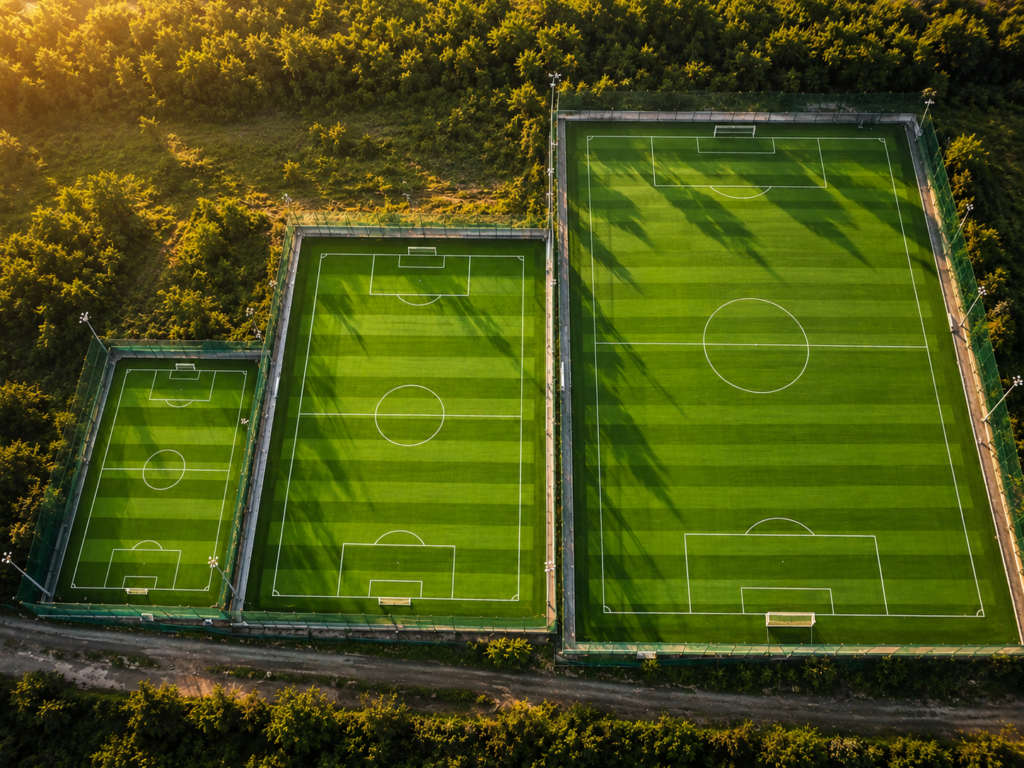
Meta Description: Confused about football turf ground sizes? Compare 5-a-side, 7-a-side, and 11-a-side dimensions, FIFA standards, costs, and which format fits your project.
Introduction
Every single client asks us this first – how much space do I need? It’s honestly the first thing people want to know before anything else, cost, turf type, none of that matters until this is sorted. And look, if you get this wrong it’s a real problem. Build too big and you’ve wasted money on land you didn’t need. Build too small and now the ground can’t even host a proper match, people will complain, trust me. So let’s just break down what 5-a-side, 7-a-side and 11-a-side actually mean in real terms, not just numbers on a page, before you go ahead with your football turf installation.
5-a-Side Football Turf
Ground Size: 20m x 30m, around 6,458 sq ft
Most people building a turf ground in a city go with this first. It’s just easier, you can find land this size, you can afford it, unlike the bigger formats where land cost alone can kill your plan. 5 players a side, games are fast, which is good for business honestly, more games in a day means more money.
Good for:
- Box football setups in cities
- Weekend games with friends or office people
- If you’re new to the turf business and don’t have a big plot
7-a-Side Football Turf
Ground Size: 30m x 40m, around 12,917 sq ft
Double the space compared to 5-a-side. You can feel the difference the moment people start playing, there’s actual room for passing, running, it feels like real football and not just everyone crowding around the ball. Schools usually want this size once they’re serious about training and not just casual play. Also works if you want to do multi sports turf on the same ground.
Good for:
- School and academy grounds
- Community clubs
- Small tournaments
11-a-Side Football Turf
This one has more rules around it. IFAB (the people who decide these things) technically say anywhere from 90m to 120m long and 45m to 90m wide is fine. Sounds like a big range but in reality almost nobody builds outside 105m x 68m, that’s what World Cup stadiums use, that’s what top leagues use, basically that’s the standard everyone follows. Comes to about 76,860 sq ft if you convert it.
This is real, full football, the kind played professionally and internationally. Not a lot of flexibility here, the rules are strict.
Good for:
- Professional academies
- Stadiums and municipal grounds
- Anyone who has both the land and the budget for lighting, drainage, everything that comes with a full size ground
Size Comparison
| Format | Dimension | Approx. Area | Players | Best For |
| 5-a-Side | 20m x 30m | 6,458 sq ft | 5 per team | City turf business, casual games |
| 7-a-Side | 30m x 40m | 12,917 sq ft | 7 per team | Schools, academies, tournaments |
| 11-a-Side | 105m x 68m | 76,860 sq ft | 11 per team | Professional, stadium level |
Which One Should You Pick
If you don’t have much land and want to start a business, go 5-a-side, simple. Cheapest option, fastest to build, and there’s always people wanting a casual game.
If it’s for a school or academy, 7-a-side makes more sense, gives kids enough room to actually learn the game properly without needing a huge plot.
If you’re going professional or competitive level, then 11-a-side is not optional, it’s the only size that’s officially recognized. Just know it needs a lot more, land, money, lighting, drainage, all built at a bigger scale.
Why Cost Goes Up So Much With Size
Something people don’t expect – going from 5-a-side to 11-a-side is not just a little bigger. It’s around 12 times the area. So 12 times the turf needed, 12 times the base work, way more labor, plus things smaller grounds don’t even need. This is exactly why most people stick with 5-a-side or 7-a-side unless there’s serious backing for the project.
But whatever size you go with, the same things matter, proper leveling, good drainage, decent turf. If you skip the base work to save some money now, you’ll probably be fixing it again within a year, maybe two. Same applies for cricket turf installation too, honestly the base always matters more than people think it does.
FAQs
What’s the smallest football turf ground possible?
5-a-side, about 20m x 30m, roughly 6,458 sq ft.
Best size to start a turf business with?
5-a-side usually, less land, less cost, and there’s steady demand from casual players.
Can I upgrade a 7-a-side ground to 11-a-side later?
Not really, that’s about 6 times more space, so it’s basically a new ground, not an upgrade to the old one.
Does ground size really change the cost that much?
Yes, quite a lot actually, more turf, more base prep, more labor. 11-a-side can cost several times more than 5-a-side, and that’s before adding drainage or lights.
Is there one official FIFA size?
IFAB technically allows 90-120m long and 45-90m wide, but almost everyone actually builds at 105m x 68m.
Is 5-a-side okay for a school?
It can work, especially for younger kids or if space is limited, but serious academies usually go with 7-a-side instead.
Why do most turf businesses in India choose 5-a-side?
Mostly comes down to land. An 11-a-side ground needs about 12 times more space than a 5-a-side one, so 5-a-side is just a lot easier to actually build and run in a city where land is expensive and hard to find.