
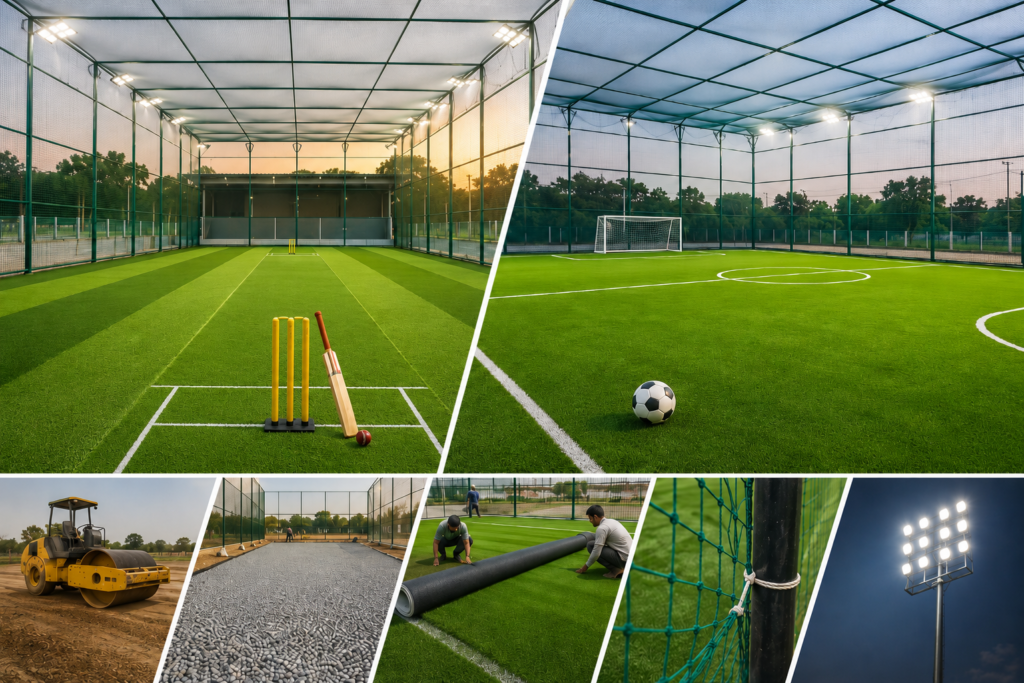
Cricket and football turf grounds are really popular in India now. Lots of schools sports academies, clubs, housing societies and private sports businesses are investing in these turf facilities. They want to meet the growing demand for sports.
A planned turf ground can be used all year round. You can have bookings, coaching sessions, tournaments and corporate matches.
Constructing a good turf is not easy. It involves a lot of things like ground size, base preparation, drainage, netting, lighting and installation quality. All these things are important for the ground to perform over time.
If you are planning to construct a cricket turf or a football turf in India you need to understand these factors. Then you can decide on the budget.
Choosing the Right Ground Size
The right ground size depends on the land you have the sport you want to support and the number of players.
A smaller setup is good for box cricket and sided football. A larger ground gives players more freedom to move around. It creates a comfortable playing experience.
5000 Sq. Ft. Turf Ground-
Cost of a 5000 sq. Ft. Turf ground is around ₹13.5 lakh to ₹18 lakh.
This size is practical for compact box cricket five-a-side football, coaching sessions and private sports facilities. It works well in places where land’s limited.. You need to plan the playing area, safety space, net structure, lighting and entry point carefully.
A 5000 sq. Ft. Turf can work well in areas, schools, clubs and locations where players prefer shorter matches or practice sessions.
6000 Sq. Ft. Turf Ground-
Cost of a 6000 sq. Ft. Ground is around ₹15 lakh to ₹20 lakh.
This size offers a balance between space, usability and construction cost. It gives players room for matches, training sessions and small tournaments. This size is suitable for schools, academies, clubs and commercial turf businesses.
You can use the ground for both box cricket and small-sided football. This allows the turf owner to accept bookings from groups.
7000 Sq. Ft. Turf Ground-
Cost of a 7000 sq. Ft. Ground is around ₹18 lakh to ₹22 lakh.
This size provides a playing area and creates a more professional sports environment. It is suitable for academies and commercial turf facilities that expect regular bookings and high player traffic.
What Does Turf Construction Cost Include?
The cost of constructing a cricket or football turf is not the price of artificial grass.
It includes:
- Site cleaning and ground levelling
- Excavation and base preparation
- Drainage work
- Aggregate filling and compaction
- Artificial grass supply and installation
- Infill material, where required
- Poles and fabrication
- Sports lighting
- Line marking and finishing
The condition of the land also affects the construction cost. Uneven ground, weak soil, waterlogging or limited access for construction machinery may require preparation and increase the cost.
FIFA-Approved Artificial Grass-
Artificial grass affects ball movement, player comfort and the lifespan of the ground.
Its quality should be checked based on fibre strength, density, backing, pile height and suitability for the sport.
Using FIFA-approved grass creates a consistent and dependable playing surface.
For football turf the grass should allow ball movement and provide proper grip. For cricket turf construction the surface and base should be selected according to the expected ball bounce and playing style.
Garware Net for the Turf Enclosure-
Strong netting is important for both cricket and football turf grounds.
It prevents the ball from leaving the playing area. Protects nearby property.
Garware net is an option for sports enclosures because of its strength and suitability for outdoor conditions.
Base Preparation and Drainage-
The quality of the base determines how well the turf performs over time.
The surface below the grass must be levelled and compacted properly. Poor base preparation can create problems like dips, unstable sections and uneven ball movement.
Drainage is also important. Rainwater should move away from the playing surface quickly. A designed drainage system can cause waterlogging and damage the turf foundation.
Lighting for Evening Play-
Evening slots are often the hours for commercial cricket and football turf grounds.
The lighting system should provide even visibility across the entire playing area.
Placed lights can create glare, shadows and dark patches on the ground. Pole height, beam angle and fixture placement should be planned before installation.
Cricket Turf, Football Turf or Both?
The right choice depends on the demand in the area.
A cricket turf can attract sports academies, local teams, corporate groups and tournament organisers.
A football turf may perform well near schools, colleges, residential societies and active sports communities.
Many turf owners prefer developing a dual-use ground that can support both cricket and football.
This can increase the number of bookings but the entire setup must be planned properly from the beginning.
Cricket and Football Turf Construction Cost-
The estimated construction cost based on ground size is:
- 5000 sq. Ft.: ₹13.5 lakh to ₹18 lakh
- 6000 sq. Ft.: ₹15 lakh to ₹20 lakh
- 7000 sq. Ft.: ₹18 lakh to ₹22 lakh
The final price may vary depending on the project location, site condition, artificial grass specification, net height, lighting requirements and additional facilities.
A successful cricket or football turf project begins with detailed planning.
Ground size, drainage, base strength, artificial grass netting and lighting should work together as one system.
Using FIFA-approved grass, durable Garware net and experienced installation support can help create a safer and longer-lasting sports facility.
The objective should not be to construct the possible ground. The aim should be to develop a turf that offers a playing experience handles regular use and requires fewer repairs in the future.
AS Sports and Infra provides support for cricket turf ground construction and football turf ground construction in India.
From site planning and material selection, to installation and final finishing every stage is managed according to the land expected usage and project budget.